Beauty Tech

Beauty tech

How long does it take before I can expect to see the first results?

The first improvements can be seen in the radiance of the complexion after a few weeks of regular use. For visible effects on the appearance of signs of ageing, firmness and skin texture, consistent use over several months is recommended. Results vary depending on the individual and skin type.

What is the recommended frequency of use?

The recommended protocol varies depending on the model. Please refer to the instructions provided with your device or to the product page on nooance-paris.com. Generally speaking, consistency is key to achieving visible results.

How long does one charge last?

Battery life varies by model. Please refer to the instructions provided with your device to find out the number of sessions per full charge. For all models, we recommend fully charging the device before first use.

How do I clean my LED mask?

Clean your mask regularly, once or twice a month, or after each session if shared or used on skin prone to blemishes.

After your session, remove the mask and unplug it. Use a soft, slightly damp cloth to wipe the surface and remove any residue. If necessary, use a mild cleanser or a disinfecting wipe, especially recommended for shared use. Never wet the electronic parts (LEDs, wires, connectors). Let it air dry completely before storing in a clean, dry place.

The eye protection hurts my eyes.

The protective goggles and the silicone eye patches are not designed to be used together. Never combine them. If the light feels too intense with the silicone eye patches alone, use only the black goggles. Combining both puts pressure on the eyes and makes the session uncomfortable.

Can I use the mask at the same time as a photosensitizing treatment?

No. We do not recommend using LED devices during a photosensitizing treatment. If you are following a specific medical treatment, please consult your doctor before any use. Their advice always takes precedence.

What are the contraindications for using the mask?

Do not use the mask in the following situations: pregnancy, plans to become pregnant, or breastfeeding, as the devices have not been tested in these situations and the risk is unknown. Lupus erythematosus, photosensitive eczema, or albinism due to a risk of severe skin reaction. Known photosensitivity or photosensitivity disorder. Epilepsy or frequent migraines. Hereditary eye diseases. Use of photosensitizing medications. If in doubt, consult your doctor before use.

Does the LED mask have medical properties?

No. Our masks are devices designed for cosmetic purposes, focused on anti-aging prevention and improving the skin's appearance. They do not constitute a medical treatment and are in no way a substitute for medical or dermatological care. If you suffer from a skin condition, please consult your dermatologist before use.

Is the LED mask compatible with exfoliating acids (BHA/PHA) and retinol?

There is no known contraindication to using exfoliating acids or retinol with the LED mask. Be sure to apply them after the session, never before. For sensitive skin, introduce retinol gradually into your routine and stay attentive to any skin reactions.

Does the LED mask help with brown spots?

Our masks have not been developed or tested for this concern. To address pigmentation spots, we recommend dedicated treatments and the personalized advice of your dermatologist.

Can the mask be used after eyebrow pigmentation or permanent hair removal?

NOOĀNCE has not conducted tests on these specific situations. We invite you to consult the professional who performed the treatment, who will be able to provide you with the contraindications suited to your situation.

Is the mask not recommended after a hair transplant?

If you have recently undergone a hair transplant, consult the specialist who performed the procedure before using an LED device on the treated area.

Is the LED mask risky for the eyes?

The red and near-infrared light used in our masks presents no known risk to the eyes during normal use. However, we recommend not looking directly at the LEDs during the session. The eye protection provided with your device should be used if you are sensitive to brightness.

The light on my mask seems to vary slightly during the session.

Slight variations in light may occur if the connector shifts slightly. This has no effect on the effectiveness of your session and does not damage either the device or the controller.

Can I use the mask daily?

There is no known scientific contraindication to daily use. However, please refer to the protocol recommended in your device's instructions. If you experience any unusual skin reaction, discontinue sessions and consult a dermatologist.

What is the shelf life of the mask?

LEDs have a nominal lifespan of up to 100,000 hours. The actual lifespan of your device depends on how often you use it and how it is stored.

I experience redness during or after the session.

Slight redness may appear during the session, particularly on thin or highly vascularized skin. This is a normal reaction linked to the activation of blood circulation. If the redness disappears quickly after the session, there is no cause for concern. If it persists or is accompanied by discomfort, discontinue the sessions and consult a dermatologist.

Can I use the mask if I have thin eyelids?

There is no contraindication for people with thin eyelids. Use with eyes open is possible. However, we recommend not looking directly at the LEDs during the session.

Can I use a serum before the mask?

Yes. We recommend applying a water-based serum before each session. The NOOĀNCE Lumière+ Radiance Mist Serum was specifically formulated and clinically studied to prepare the skin for LED light. Avoid lipid-based serums, creams, pure vitamin C, and retinol before the session, and apply them afterwards instead.

Is it normal for the mask to heat up?

Yes, this is completely normal. The slight warmth you feel mainly comes from the skin itself, whose blood circulation is activated by the LED light. The mask's silicone may reflect this warmth. If the sensation feels excessive, please contact our customer service via the contact form

Does a more powerful LED mask give better results?

No. Skin doesn't respond to the maximum dose — it responds to the right dose. Below the activation threshold, the energy delivered is insufficient to trigger a cellular response. Beyond it, the benefit plateaus, or even reverses. This phenomenon, documented in the scientific literature, has a name: the biphasic response.NOOĀNCE's entire approach is built on this principle: bringing skin into this therapeutic window, and keeping it there. This is what NOOANCE masks make possible — calibrated irradiance (minimum 45 mW/cm²), direct contact with the skin thanks to our medical-grade silicone architecture, and a protocol designed to deliver the right dose, at the right time.

Why 10-minute sessions?

Because exposure time follows the same principles as intensity. Beyond the cellular saturation threshold, extending the session doesn't amplify results — it only increases the energy delivered without any biological benefit in return. Sessions are calibrated to reach exactly the desired energy dose, consistent with the irradiance of our masks.

How do you compare the irradiance of two LED masks?

The total power of a device, expressed in watts, does not indicate what the skin actually receives. Only irradiance — the density of light received per square centimeter of skin, in mW/cm² — is relevant for assessing a device's effectiveness. Yet this value depends directly on the distance between the light source and the skin: the greater the distance, the more the light disperses, and the more irradiance drops. A figure stated without specifying distance is clinically meaningless.

How does NOOĀNCE measure the irradiance of its masks?

Our masks are designed to hug the contours of the face. That's why we measure light under real usage conditions: in direct contact with the medical-grade silicone, wavelength by wavelength — 633 nm and 830 nm measured separately, with an accuracy of ± 2 nm — using a calibrated surface power meter. This is the only method that faithfully reflects the dose received by the skin during a session.

BEAUTY TECH - HEADSETS

What results can I expect with the LASER & LED X400 or Expert X600 Helmet?

The X400 Helmet fits into your hair routine as a true beauty ritual to care for your hair in depth, every day. While conventional hair care works on the outer scale of the fiber, the X400 acts at the heart of the scalp, right from the root. It enhances the beauty of the hair, transforms the fiber for thicker, more resilient hair, strengthens hair weakened by daily stressors (heat, coloring, sea, sun) and helps support the growth of existing hair.*

The X600 Expert Helmet is designed to target visible, established density loss. With 600 LASERS and LEDs for an ultra-dense, even coverage across the entire scalp, it helps slow down hair loss, strengthens existing hair right from the root for a stronger, thicker fiber, and redensifies the hair for a visibly denser, fuller look.*

Results are progressive and build up with regular sessions. Results may vary from person to person.

*Independent clinical studies conducted by GREDECO, a French laboratory, under dermatological supervision — protocols No. D164.12.25 (X400) and No. D166.12.25 (Expert X600). Results may vary from person to person.

How long will it take to see a difference?

Results build up gradually. Hair follows a biological cycle measured in months, not weeks: this is the timeframe to keep in mind.

Consistency in sessions is key. The first results are generally observed between 2 and 4 months, and may vary from person to person.

Does the helmet help slow down hair loss?

Yes. Our LASER & LED technology works deep within the scalp to help slow down hair loss and help preserve hair density. The results of our helmets are clinically proven.*

The X400 Helmet and the Expert X600 Helmet both act on hair loss. The Expert X600, with its mesh of 600 LASERS and LEDs, offers a denser and more even action across the entire scalp.

However, the helmet does not stop hair loss permanently: it is a cosmetic device that accompanies the hair. In case of significant or sudden hair loss, consult a dermatologist.

*Independent clinical studies conducted by GREDECO, a French laboratory, under dermatological supervision — protocols No. D164.12.25 (X400) and No. D166.12.25 (Expert X600). Results may vary from person to person.

Pourquoi les nouveaux casques n’ont-ils plus qu’un seul mode ?

Nos précédents casques proposaient deux modes d’utilisation : un mode continu et un mode pulsé. Ce dernier, que nous privilégions pour ses performances, pouvait néanmoins générer un léger bruit lors de son utilisation et ainsi gêner certains utilisateurs.

Avec cette nouvelle génération, nous avons optimisé notre technologie afin de conserver tous les bénéfices du mode pulsé, tout en supprimant cette nuisance sonore.Nous avons donc fait le choix de ne conserver que ce mode, afin de proposer un protocole à la fois performant, simplifié et plus confortable au quotidien.

Cette évolution nous permet ainsi d’aller à l’essentiel : un seul mode, optimisé pour offrir la meilleure efficacité possible.

Does the helmet make hair grow back where it's no longer present?

No. The helmet acts on existing hair: it promotes its growth and helps strengthen it from the root.

This is precisely why it is more relevant to act early, from the very first signs of density loss.

Are the results permanent?

No. The device supports hair health only while the routine is followed: it is ongoing care, not a permanent result. Stopping the sessions ends this support.

Should it be taken in cycles?

The device is a beauty tool that supports your hair as part of a routine. Once your concern is addressed, you can stop using it or continue if you wish.

Why did we choose these technological parameters?

The X400 and Expert X600 Helmets are a new generation, built on what we have learned. Three years of development, independent clinical studies conducted by GREDECO, a French laboratory, on our previous models, and ISO 13485 certification that demands rigorous design standards: every parameter has been validated, refined, and pushed further.

This work has led to precise choices, documented and proven on our own devices:

  • 655 nm wavelength: the wavelength validated by our clinical studies on our helmets.
  • Irradiance of 7 to 10 mW/cm²: the light power calibrated for use on the scalp.
  • Fluence of 6 to 9 J/cm² per session: the dose delivered over 15 minutes.
  • 15-minute session, every other day: the protocol chosen for both devices.
Why combine LASERS and LEDs?

Because they diffuse light differently. LASERS emit a narrow, direct beam for targeted action. LEDs, wider in scope, ensure even coverage of the entire scalp. Combining them means benefiting from both at once: the precision of LASER and the complete coverage of LED.

Have your helmets been clinically proven?

Yes. Our previous models were the subject of independent clinical studies, conducted in France by GREDECO, under dermatological supervision. These results directly informed the design choices of the X400 and Expert X600 Helmets.

Clinical efficacy studies are currently underway on these new models, conducted by GREDECO, an independent French laboratory, under dermatological supervision. We chose to run them over 6 months, because that's the true hair cycle: it's at this point that real results are observed, not at 2 months. We are currently halfway through, and the first interim results are in.*

*Independent clinical studies conducted by GREDECO, a French laboratory, under dermatological supervision — protocols no. D164.12.25 (X400) and no. D166.12.25 (Expert X600). Results may vary from person to person.

Why do your helmets use only one wavelength?

Many hair devices display several wavelengths. What's rarely mentioned: each additional wavelength reduces the energy available for the others. The more wavelengths a device multiplies, the more the sources are divided, and the more the irradiance of each wavelength decreases.

We made the opposite choice. All our sources, both LASERS and LEDs, emit at a single wavelength, 655 nm, so that each one receives the maximum available energy. Moreover, the wavelength we chose is the one validated by NOOANCE clinical studies, whose effects have been clinically demonstrated.

How do you ensure your measurements are reliable?

NOOĀNCE manufactures its products and develops them within the EN ISO 13485 framework, the design and quality standard used for medical-type products. Our products are not medical devices, but applying this standard requires us to uphold demanding design rigor.

During production, each device is individually tested. Among the criteria checked: battery life and performance, irradiance measurement, and spectral precision of each source. Results are recorded in a batch file and each product is individually traceable.

Our ISO 13485 certification is audited each year by Bureau Veritas. In addition, we commission SGS, an independent laboratory present in 115 countries, to objectively verify the compliance and performance of our products.

It is this level of rigor that allows us to communicate precisely about our parameters: irradiance, spectral precision, fluence per session.

What is the difference between the NOOĀNCE Laser & LED Helmet X400 and the Expert X600?

All our helmets share the same technological expertise: a dual LASER and LED technology at 655 nm, developed and validated by our clinical studies. What sets them apart is the density of the light mesh and the proportion of LASERS.

  • The X400 Helmet: 100 LASERS and 300 LEDs, for 400 sources in total. It's the daily hair beauty ritual: it helps slow hair loss, stimulates the growth of existing hair, enhances hair beauty, transforms the fiber for thicker, shinier hair, and strengthens hair weakened by daily stress. With a reinforced density of LASERS on the most exposed areas: temples, hairline and vertex.*
  • The Expert X600 Helmet: 300 LASERS and 300 LEDs, for 600 sources in total, for an ultra-dense, even mesh across the entire scalp. Designed to act on visible, established density loss: it helps slow down hair loss, redensifies hair and strengthens existing hair from the root for a stronger, thicker fiber.*

*GREDECO clinical efficacy studies, protocols no. D164.12.25 (X400) and no. D166.12.25 (Expert X600). Results may vary from person to person.

What is the difference between the new generation of helmets (X400 and Expert X600) and the previous ones (Beauty & Regrowth and Anti-Hair Loss & Regrowth)?

Here's what sets the two generations apart:

What stays the samethe core technology remains the same: a combination of LASER diodes and red LEDs at 655 nm, direct contact with the scalp, based on the principle of hair photobiomodulation.

What has evolved:
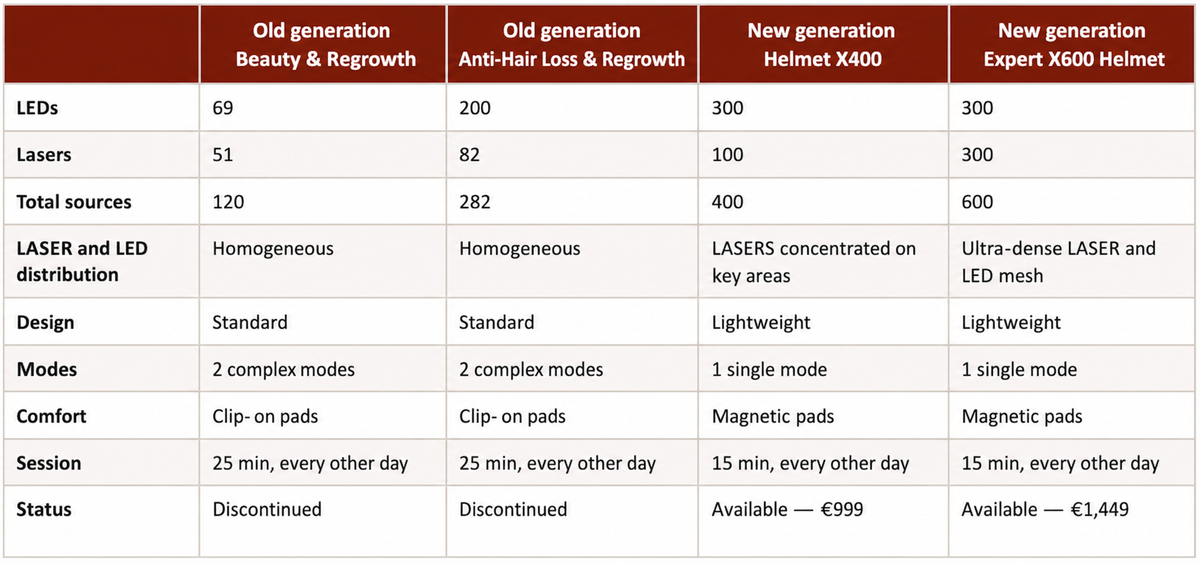


What evolves is the number of sources, the session duration, and the comfort of use. These improvements result from ongoing work: customer feedback, clinical studies conducted on our previous models, and internal research. With each generation, we aim to offer our customers the most refined product possible.

Why have sessions gone from 25 to 15 minutes with the new generation?

Compared to our previous models, session duration has been reduced from 25 to 15 minutes. This is due to increased delivered energy, irradiance and fluence in joules, which allows the target dose to be reached in less time. Less time per session does not mean less effectiveness: it is precisely because the dose is maintained that the protocol works. What remains unchanged: consistency is still key. One session every other day, without prolonged interruptions.

Are there different modes on this new generation of helmets?

No, the helmet operates with a single mode, designed for simple use with no adjustments needed.

Is the Expert X600 more powerful than the X400?

Both devices rely on the same parameters: 655 nm, 15-minute sessions every other day. The difference lies in the number of LASERS — 100 on the X400, 300 on the Expert X600 — and therefore in the density of the light mesh.

The choice depends on your situation: the X400 to enhance the beauty of the hair, transform the fiber and maintain its quality daily; the Expert X600 when density loss is already visible and established.

Is the technology the same as on previous NOOĀNCE helmets?

The principle remains the same: dual LASER and LED technology validated by our clinical studies. What evolves is the number of sources, the density of the mesh and the comfort of use. Three years of development, clinical studies and field feedback have allowed us to go further and offer a new generation of helmets.

Is my old helmet now obsolete?

No. It's still NOOĀNCE technology. The new generation is simply more powerful, with a denser mesh, shorter sessions and improved comfort. This does not make your current helmet any less relevant: it was designed according to rigorous specifications and it meets them. We simply keep advancing our devices with each generation.

Can I use the helmet if I already have a NOOĀNCE LED face mask?

Yes. Both devices target different areas and don't compete with one another: the mask focuses on the face, the helmet on the scalp. They can be used on the same day, in whichever order suits you.

How often should I use it?

We recommend a 15-minute session every other day. This is the protocol used for both helmets and the one applied in the GREDECO clinical studies.*

Increasing the frequency provides no additional benefit. However, avoid prolonged interruptions: consistency is key to achieving results.

*GREDECO clinical efficacy studies, protocols No. D164.12.25 (X400) and No. D166.12.25 (Expert X600). Results may vary from person to person.

Is the helmet suitable for both women and men?

Yes, in both cases.

The X400 is designed for everyone, regardless of hair type or age. It's the beauty ritual that completes your haircare routine: while your products nourish and beautify the fiber on the surface, the X400 works at the heart of the scalp, right from the root.

The Expert X600 is designed for those facing an already visible and established loss of density, for a denser, more targeted action across the entire scalp.

Why do the sessions last 15 minutes?

The session duration is calculated based on the helmet's irradiance to deliver a fluence of 6 to 9 J/cm² per session. Regular sessions make it possible to deliver this dose each time, without having to extend the exposure time.

How do I adjust the size of the helmet?

Two cushion sizes are included, small and large. Choose the one that best fits the size of your head and attach it using the magnetic system. The helmet should sit snugly on your head, without any pressure.

I skipped several sessions—should I start the protocol over?

No. Simply resume your usual routine, one session every other day. There's no need to make up for missed sessions.

Can I use it with my usual hair care products?

Yes. The session takes place on dry hair with no product on the scalp. Apply your treatments, including the Scalp Serum, after the session.

Do not use photosensitizing active ingredients in high concentration in the hours before the session. If in doubt, consult your dermatologist.

How do I clean the helmet?

Before cleaning, turn off the device. Wipe the inner surface and cushions with a soft cloth lightly dampened with water. Never immerse the helmet and do not use solvents or abrasive products. Allow to air dry.

I'm losing more hair since I started using the helmet, is this normal?

Yes, this can happen, and it is temporary. This is known as a purging phenomenon.

Stimulating the hair cycle accelerates the shedding of hair that is already at the end of its cycle, in the telogen phase, dead but still attached, to make way for new hair in the growth phase. These are therefore not "living" hairs falling out.

This phenomenon is generally observed over the first two months, then fades. It does not affect everyone.

Are there any special precautions to take?

Yes. Before first use, we recommend reading the instructions provided with the helmet. It details all the warnings, contraindications, and precautions to follow, particularly in cases of pregnancy, medical treatment, scalp conditions, or for individuals under 18 years of age.

If you are unsure about your personal situation, please consult your doctor or dermatologist before use.

Are there any contraindications?

Yes. The use of the helmet is contraindicated in the following cases: known photosensitivity or skin reaction to light; pregnancy and breastfeeding; active cancer or cancerous lesion; suspicious or precancerous lesions; ongoing photosensitizing medication; history of epilepsy or light-triggered seizures; open wounds, infection or irritation of the scalp; recent surgery or laser treatment on the area; fever, acute inflammation or severe circulatory disorder.

Two clarifications:

Photosensitivity: our helmets emit no UV radiation, but the entire light spectrum may cause a reaction in photosensitive individuals. Before the first session, we recommend carrying out the sensitivity test described in the instructions.

Pregnancy and breastfeeding: use is not recommended as a precautionary measure. No studies have been conducted on pregnant or breastfeeding women, which prevents us from providing guidance.

If in doubt, consult your doctor or dermatologist before use.

Is it dangerous for the eyes?

No. The light is directed inward, toward the scalp, and the device's design prevents any direct exposure to the eyes. Two sensors also ensure that the helmet only switches on when properly positioned on the head. Do not look directly at the light sources while the device is on.

I feel a slight tingling sensation during the session, is this normal?

Some people may experience a mild tingling sensation during or after the session. If the discomfort persists or intensifies, stop using the device and contact our customer service.

Does it heat up?

A slight feeling of warmth may occur during the session: this is normal. It comes from the LASERS, which concentrate more energy than the LEDs on a smaller area. This sensation remains mild and fades by the end of the session. If it becomes uncomfortable, stop the session and contact our customer service.

BEAUTY TECH – GENERAL

Can Beauty Tech devices be used during chemotherapy?

No. We strongly advise against using our devices during chemotherapy treatment. Devices that act on cells should not be used while the body is undergoing oncological treatment. The helmet may, however, be considered after the end of treatment, to help support hair regrowth, subject to medical advice. For any health-related question, your doctor's opinion always takes precedence.

From what age can NOOĀNCE Beauty Tech devices be used?

Our devices are recommended for use from age 18 onwards. All of our clinical studies were conducted on adult volunteers. For minors, please seek your doctor's advice before any use.

Can the mask and headset be used at the same time?

Yes, there is no contraindication to using both devices in parallel. Follow the recommended protocol for each device.

I have melasma. Can I use the LED mask?

As melasma is a condition particularly reactive to light stimulation, we recommend consulting your dermatologist before any use. They will be able to assess whether use is suitable for your specific situation.

Can I travel by plane with my devices?

Yes. The devices are allowed in the cabin. If you wish to check them in your hold luggage, keep the remote control or the battery with you in the cabin, as major airlines refuse lithium batteries in checked baggage. If in doubt, check your airline's conditions.

De la buée ou de la condensation apparaît à l'intérieur de mon masque : est-ce normal ?

Oui, cela peut arriver et il ne s'agit pas d'un défaut.

Comme tout appareil comportant une surface souple fermée, votre masque peut présenter de légères traces de condensation sur sa face interne. Ce phénomène est purement physique : il apparaît lorsque l'appareil passe d'un environnement à un autre présentant une température ou un taux d'humidité différent, par exemple après un stockage dans une salle de bain, une pièce humide, ou après un transport au froid.

Ces traces s'estompent d'elles-mêmes et n'ont pas d'incidence sur les performances de votre masque.